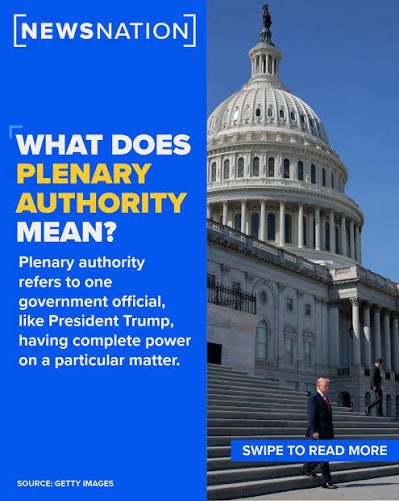

Plenary authority is a legal and administrative term used to describe complete, full, or unrestricted authority over a particular matter. When a person, institution, court, government body, or other authorized entity has plenary authority, it generally means that its power is not limited within the scope granted by the relevant law, constitution, agreement, or governing instrument.
The phrase can appear complicated because its exact meaning depends heavily on the context in which it is used. In constitutional law, administrative law, international relations, courts, immigration matters, and organizational governance, plenary authority may carry slightly different implications.
Understanding the term requires more than simply translating “plenary” as “full.” It is important to determine who possesses the authority, where that authority comes from, what subject it covers, and whether another legal rule places limits on it.
What Does Plenary Authority Mean?
The simplest definition of plenary authority is full authority to act within a specified area of responsibility.
The word plenary comes from a term meaning full or complete. Therefore, when authority is described as plenary, the expression suggests that the holder has broad decision-making power rather than merely a narrow or delegated function.
For example, if a governing body has plenary authority over a particular administrative process, it may have broad discretion to establish procedures, make decisions, and take actions that fall within its legally recognized jurisdiction.
However, plenary does not automatically mean unlimited.
A person or institution may have extensive authority over one subject while having no authority over another. Even broad powers may remain subject to constitutional requirements, legislation, judicial review, procedural rules, fundamental rights, or other legal restrictions.
Plenary Authority Definition in Simple Terms
In everyday language, plenary authority can be understood as:
The full power to make decisions or take action within a particular area of legal responsibility.
This definition contains an important qualification: the authority must exist within its proper scope.
For example, an organization may give its director plenary authority to negotiate a particular contract. That does not necessarily mean the director has unlimited power over every decision the organization makes.
The scope of authority is therefore essential.
What Is the Difference Between Plenary and Limited Authority?
The distinction between plenary and limited authority is relatively straightforward.
Plenary authority generally provides broad powers within a defined field.
Limited authority restricts the decision-maker to particular actions, subjects, procedures, or circumstances.
Consider a hypothetical government agency. If legislation gives the agency plenary authority over licensing within a specific industry, the agency may have considerable discretion concerning licensing decisions. If the legislation instead allows the agency only to process applications according to a detailed set of prescribed rules, its authority would be much more limited.
The difference is not necessarily about whether the authority is important. It is about how broadly the law defines the decision-maker’s power.
Is Plenary Authority the Same as Unlimited Power?
No.
This is one of the most important points when discussing plenary authority.
The word “plenary” can suggest absolute power, but legal authority almost always exists within a framework. A constitution, statute, treaty, court decision, organizational charter, or other legal instrument may establish boundaries.
For example, an institution may have plenary authority over a specific subject but still be required to:
- Follow applicable legislation
- Respect constitutional provisions
- Observe procedural requirements
- Remain within its jurisdiction
- Protect applicable legal rights
- Comply with binding court decisions
- Exercise power for a lawful purpose
Consequently, the phrase should normally be interpreted as full authority within the relevant legal scope, rather than unrestricted power over everything.
Sources of Plenary Authority
Plenary authority can come from several different sources.
Constitutional Authority
A constitution may assign broad powers to a particular branch or institution of government. The extent of those powers depends on the constitutional system involved.
Constitutional provisions can establish responsibilities while also defining limits and relationships between different government institutions.
Statutory Authority
Legislatures can create agencies or offices and provide them with broad authority over specific areas.
A statute may, for example, give an administrative body substantial responsibility for regulating a particular industry. Whether that authority is truly plenary depends on the language of the statute and other applicable law.
Delegated Authority
An organization or institution may delegate significant decision-making powers to another person or body.
Although delegated authority can be broad, the delegate generally remains subject to the conditions under which the authority was granted.
Contractual or Organizational Authority
Businesses, associations, universities, and other organizations may use governing documents to establish broad powers for particular officers or committees.
In these circumstances, the organization’s internal rules determine the extent of the authority.
Plenary Authority in Constitutional Law
The term has particular significance in constitutional law.
Governments divide responsibilities among different institutions. Legislatures create laws, executive authorities administer them, and courts interpret and apply legal rules. The precise balance differs from one legal system to another.
When a particular governmental institution is described as having plenary authority, the phrase generally indicates that it possesses broad power over the subject assigned to it.
However, constitutional systems frequently impose checks on governmental power. A legislature with broad authority over a particular matter may still be constrained by constitutional provisions.
Therefore, determining whether authority is genuinely plenary requires examining the relevant constitutional text, legislation, precedent, and legal principles.
Plenary Authority in Administrative Law
Administrative agencies often operate under authority granted by legislation.
An agency may receive broad powers to administer a regulatory program. It may then create rules, issue decisions, grant licenses, conduct investigations, or enforce requirements depending on the powers provided by law.
Calling such authority “plenary” does not necessarily mean the agency can do anything it wants.
Administrative agencies generally must act within the authority granted to them. Courts may examine whether an agency has exceeded its statutory powers or failed to follow legally required procedures.
This is why the source and scope of authority matter so much in administrative law.
Plenary Authority and Judicial Review
Another important concept is judicial review.
Even when a decision-maker possesses broad authority, courts may sometimes examine whether that authority has been exercised lawfully.
For example, a court may consider whether an authority:
- Had legal jurisdiction
- Acted within its statutory powers
- Followed required procedures
- Applied the relevant legal standards
- Exercised discretion for a lawful purpose
The existence of judicial review does not necessarily eliminate plenary authority. Instead, it can provide a mechanism for determining whether the authority has been exercised within its legal boundaries.
Plenary Authority vs. Discretion
Plenary authority and discretionary power are related but not identical concepts.
Authority concerns the legal power to act.
Discretion concerns the freedom to choose between legally permissible options.
A decision-maker can possess broad authority but still have limited discretion because legislation may specify how certain decisions must be made.
Conversely, a decision-maker may have discretion in a particular area without possessing broad authority over the entire subject.
Understanding this distinction helps prevent confusion when reading legal documents.

Why the Scope of Plenary Authority Matters
Whenever the phrase appears in a legal or professional document, readers should ask several questions.
Who has the authority?
Identify the person, institution, agency, court, or organization exercising the power.
What is the source?
Look for the constitution, statute, regulation, contract, charter, or other document that creates the authority.
What subject does it cover?
Plenary authority usually applies to a particular field rather than every conceivable matter.
Are there restrictions?
Even broad authority may be subject to procedural, constitutional, statutory, or judicial limitations.
Can the decision be challenged?
The availability of appeals, judicial review, administrative review, or other remedies may depend on the relevant legal system.
These questions provide a much more accurate understanding than relying on the word “plenary” alone.
Examples of Plenary Authority
A few hypothetical examples can make the concept easier to understand.
Example 1: Government Agency
Suppose Parliament creates a regulatory agency and grants it broad authority over professional licensing. The agency may have extensive powers to establish licensing procedures and make individual licensing decisions.
Its authority could be described as plenary within the area assigned by law, but it would still need to comply with the legislation establishing it.
Example 2: Corporate Governance
Imagine a company’s board grants a committee full authority to negotiate a specific acquisition. The committee may have broad power to negotiate the transaction, but its authority does not automatically extend to unrelated company matters.
Example 3: Court Proceedings
A court may have broad jurisdiction over a particular class of cases. Its powers within that jurisdiction can be extensive, but they remain subject to the applicable constitution, legislation, procedural rules, and higher judicial authority.
These examples demonstrate why context is essential.
Advantages of Granting Plenary Authority
Granting broad authority can have practical advantages.
Faster Decision-Making
A decision-maker with broad authority may not need approval for every minor step. This can reduce delays.
Clear Responsibility
Assigning substantial authority to one institution can make it easier to identify who is responsible for a particular area.
Administrative Efficiency
Organizations may operate more efficiently when qualified decision-makers can respond without constantly seeking additional authorization.
Flexibility
Broad authority can allow decision-makers to respond to changing circumstances without requiring new instructions for every situation.
Potential Risks of Broad Authority
Plenary authority can also create concerns if it is poorly defined or improperly exercised.
Concentration of Power
Giving extensive authority to one person or institution can concentrate decision-making power.
Lack of Oversight
Broad authority may create problems if appropriate accountability mechanisms are absent.
Legal Disputes
Unclear boundaries can result in disagreements over whether an action falls within the decision-maker’s powers.
Abuse of Discretion
Where broad discretion exists, safeguards may be necessary to prevent arbitrary or improper decisions.
For this reason, legal systems often combine broad powers with oversight, procedural requirements, review mechanisms, and accountability.
How to Interpret Plenary Authority in a Legal Document
If you encounter the phrase in a contract, statute, court document, or organizational policy, do not interpret it in isolation.
Start by locating the provision that grants the authority. Then examine the surrounding language for qualifications such as “subject to,” “within,” “provided that,” or “in accordance with.”
These phrases can significantly affect the practical meaning of the authority.
It is also useful to identify whether the document defines specific powers elsewhere. Sometimes a provision initially appears to grant complete authority but later sections establish important restrictions.
For complicated legal matters, professional legal advice may be appropriate because the meaning of authority can depend on jurisdiction and case-specific facts.
Common Misunderstandings About Plenary Authority
One common misconception is that plenary authority means a person can act without any legal restrictions. That is usually too broad.
Another misunderstanding is that every form of broad authority is automatically plenary. The exact legal language and context matter.
It is also incorrect to assume that plenary authority cannot be reviewed. Depending on the legal system and the nature of the decision, courts or other oversight bodies may have mechanisms for reviewing the exercise of power.
The safest approach is to view plenary authority as broad legal power within an established field, rather than absolute power without boundaries.
Plenary Authority vs. Full Authority
The terms “plenary authority” and “full authority” can sometimes be used similarly in ordinary language. However, “plenary authority” has a more specialized legal meaning.
“Full authority” may simply mean that someone has been given permission to make a decision.
“Plenary authority” can communicate that the authority is comprehensive within a particular subject or jurisdiction.
Still, the exact meaning depends on the document and legal context.
Why Understanding Plenary Authority Matters
Understanding plenary authority is useful for anyone reading legal, governmental, corporate, or administrative documents.
The phrase can determine who has the power to make a decision, how broadly that power extends, and what limitations apply.
For businesses, it can help clarify the responsibilities of directors, officers, committees, and representatives. For citizens, it can help explain the powers of public institutions. For students, it is an important term in constitutional and administrative law.
Most importantly, it teaches a broader lesson about legal language: words describing power must always be read together with the source and limits of that power.
Final Thoughts
Plenary authority generally refers to broad or complete legal authority within a defined area. It can provide decision-makers with substantial flexibility, improve administrative efficiency, and clarify responsibility.
At the same time, plenary authority should not automatically be interpreted as unlimited power. Its practical boundaries depend on the constitution, statutes, regulations, contracts, organizational rules, jurisdiction, and other applicable legal principles.
When you encounter the term, the best approach is to ask where the authority comes from, who possesses it, what matters it covers, and what limitations or review mechanisms apply.
That context transforms a potentially confusing legal phrase into a much clearer concept: plenary authority is broad power, but its true extent is determined by the legal framework that creates it.
Frequently Asked Questions About Plenary Authority
What is plenary authority?
Plenary authority generally means full or broad authority over a particular subject or area of responsibility.
Does plenary authority mean unlimited power?
No. Plenary authority is generally broad within its legally defined scope, but it may still be subject to constitutional, statutory, procedural, or judicial limitations.
What does plenary mean in law?
In legal usage, “plenary” generally means full, complete, or comprehensive in relation to the matter being discussed.
Who can have plenary authority?
Governments, courts, administrative agencies, corporate bodies, committees, officers, and other legally recognized entities can possess broad authority depending on the applicable legal framework.
Is plenary authority the same as discretionary authority?
Not exactly. Plenary authority concerns the breadth of legal power, while discretion concerns the freedom to choose among legally available options.
Can plenary authority be challenged?
Depending on the jurisdiction and circumstances, the exercise of broad authority may be subject to appeals, judicial review, statutory restrictions, or other oversight mechanisms.
Why is plenary authority important?
It helps define the extent of a decision-maker’s power and can determine who is legally entitled to make decisions within a particular area.
How do I determine whether authority is plenary?
Examine the document or law that grants the power, its surrounding provisions, the relevant jurisdiction, and any restrictions or review mechanisms.
Is plenary authority always permanent?
No. Authority can be changed, limited, delegated, revoked, or replaced depending on the legal instrument that created it.
What is the simplest meaning of plenary authority?
In simple terms, it means broad or full power to act within a particular area of responsibility.